Thursday, June 22, 2006

Koli Curry: Flavorful chicken curry from Coorg


Coorg is a beautiful region located in the Western Ghats in the southern Indian state of Karnataka. The people of Coorg -- Kodavas -- a brave, extremely good-looking race are fun loving and carry with them the beauty of their region. The region of Coorg, rich in coffee and spice plantations also has the most amazing cuisine. The Koli (chicken) curry and 'nool puttu' or rice noodles are only two of the best known dishes from this really picturesque Indian hill station. The recipe below is for Koli curry, it is really easy to make and tastes so good that it deserves pride of place in any spice-lover's favorite dinner party menu.


The Recipe


1 kg chicken cut and cleaned
1 large onion chopped fine
juice of 1 lemon
2 cups warm water
1/2 cup grated coconut
1 teaspoon tumeric powder
2 teaspoons chillie powder
salt to taste
oil for frying

In a mortar and pestle (or blender) make a paste of the following:

1 tablespoon whole coriander seeds
1 piece of cinnamon
4 cloves
1 inch piece ginger
5 cloves of garlic
1/2 teaspoon poppy seeds (posto)
1/2 teaspoon cumin seeds
1 bunch fresh coriander leaves chopped coarse (wash roots and stems well and include it in the paste)

Separately make a thick paste of the fresh grated coconut


In a large well heated pan add some oil and when it is smoking hot, add the onions and fry till translucent; add salt and the ground spice paste. Fry very well till a delicious fragrance is released, then add the chicken pieces and continue to fry well till the chicken is well coated with the spice paste. Pour in the two cups of warm water, bring to a boil, then cover reduce heat and simmer till chicken is cooked through.
Stir in the coconut paste gently, add the lemon juice and simmer about 2-3 minutes. Then remove from heat and serve hot with steamed white rice.

Wednesday, June 21, 2006

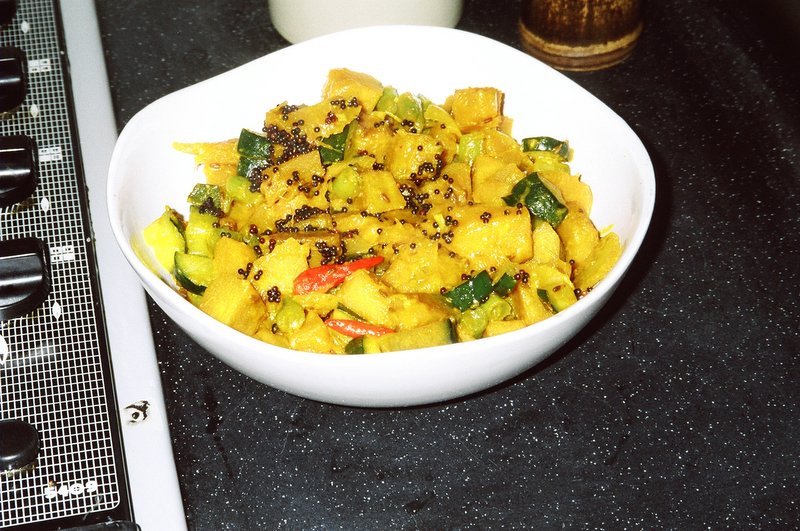
Pumpkin with yogurt and black mustard seeds


Thinking up vegetable dishes for everyday Indian meals can be a bit of a challenge. The other night I sort of created this surprisingly delicious pumpkin (called lal kumro or red pumpkin in Bengali) dish that takes little time and even less effort. Serve it hot with rice or rotis or even use it as an unusual sandwich filling.


The Recipe


200 gm pumpkin cubed
a handful of French beans cut into smallish pieces
1 Japanese cucumber cubed
1 teaspoon cumin seeds
2-3 slit green or red fresh chillies
1 teaspoon tumeric powder
1 tablespoon yogurt
1 teaspoon black mustard seeds
salt to taste
oil for frying


Heat the oil, add the black mustard seeds and when they start to splutter add the cubed vegetables and stir-fry quickly. Add salt, tumeric and chillies and keep frying for a few minutes. Reduce heat and cover and let the vegetables sort of cook in their own steam.
When the vegetables are nearly cooked (around 10 minutes) stir in the tablespoon of yogurt. Mix very well and remove from heat. Serve hot.

Friday, June 16, 2006

Fish curry in a piquant mustard gravy


This is an adaptation of a treasured Bengali recipe. The reason I say 'adaptation' is that I've added a few cubed vegetables to the curry, while in Bengal it is generally prepared with fish and potatoes only. Cooking fish with a pungent, piquant freshly ground mustard paste ('shorshe baata') is one of the commonest (and most delicious) fish preparations throughout Bengal. I normally use a stone mortar and pestle, if you don't have one a regular blender works just fine.


The Recipe

Make a paste using a mortar and pestle (or blender) of the following with a bit of water:

a little more than 1/4 cup black mustard seeds
4 fresh green or red chillies


3-4 medium sized fish steaks (milk fish, cod, carp) rubbed with salt and tumeric powder and kept aside
1 medium sized eggplant cubed
3-4 okra cubed
1 potato cubed (skin on, well washed)
2 tomatoes quartered
1 teaspoon sugar
1 teaspoon tumeric powder
salt to taste
oil for frying


Fry the tumeric coated fish in hot oil a few minutes each side, till crisp and golden. Keep aside.
In the same oil, put the mustard-chillie paste and fry a few seconds, add a teaspoon or two of warm water, the tomatoes and sugar and fry well for a couple of minutes on medium heat. Add the cubed vegetables and keep frying (add a little more water if needed, just to keep the mixture a little thick). Add the fish, fry carefully making sure the pieces do not break. When the fish and vegetables are well coated with mustard, add salt and about two cups warm water. Reduce heat and simmer for about 12 minutes or till the vegetables are cooked.
Serve hot with white rice.

Tuesday, June 13, 2006

Fish curry with pumpkin and sweet potatoes


Typically Indian curries do not mix vegetables and meat or fish (that is of course if we don't count potatoes as vegetables). I'm not sure why this is so especially as in most east and south east Asian countries one-pot meals are quite common. In india we do find the odd curries of Bengal where fish is cooked with cauliflower florets or big cubes of 'potol', but like I said around the country as a whole, usually the meat/ fish etc is cooked by itself and the vegetable dishes are served separately.

Having lived in east Asia for a while now, I've got quite used to mixing up my meat/ fish with a selection of vegetables -- in essence creating a convenient one-pot meal. I've also got used to experimenting with spices and curry pastes, retaining a basic Indian flavor but freely borrowing from Asian techniques and ingredients that seem to me to go well with Indian spice mixes. The recipe below is the result of this sort of experimentation. In this dish I've used small chopped bits of fresh coconut -- it adds a delicious crunchy texture to the dish. Fresh coconuts are not always easily available, a good substitute would be a handful of lightly fried unsalted cashew nuts.


The Recipe


4 fish steaks (use a nice fish that absorbs flavors well like cat fish or carp)
200 gm sweet pumpkin cubed
1 large sweet potato peeled and cubed
2 tomatoes (medium sized) chopped fine
handful of curry leaves
2 tablespoons fresh coconut chopped into little cubes (or the cashew nut substitute)
1 teaspoon tumeric powder
1 teaspoon coriander powder
1 teaspoon sugar
salt to taste
oil for frying

Make a paste of the following using a mortar and pestle or blender:
2 shallots
1 inch piece ginger
3-4 fresh green or red chillies
1 teaspoon whole white pepper


Wash and pat dry the fish on kitchen towels. Rub some salt and tumeric powder on the fish and keep aside for about 10 minutes. Heat some oil in a pan and when smoking, put in the fish and fry about 2 minutes on each side till fish turns nice and golden. Keep the fried fish aside.
Add some more oil to the pan, put in the spice paste and fry well for a couple of minutes; add the teaspoon of tumeric and coriander powder, the tomatoes, salt and sugar. Fry some more and then add the vegetables and curry leaves and about a tablespoon of warm water. Fry very well 6-8 minutes till the vegetables are well coated with the paste.
Add about two cups of warm water bring to a boil and then lower heat and simmer another 6-8 minutes. Add the fried fish and coconut pieces and simmer again for about 5 minutes. Remove from heat and serve hot with steamed white rice.

Saturday, June 10, 2006

Poha: Savory rice flakes


This picture shows black mustard seeds (rye)

::::::::::::::::::::::::::::::


Snack food in India probably deserves an encyclopedia of its own. An amazing variety of fritters (telebhajas, pakoras or bhajis) is prepared from all kinds of vegetables, even vegetable peels -- in Bengal, fish, shrimp; small dosas called utthapams; varities of dried rice and rice flakes known as poha and muri are lightly spiced and served with hot tea; bhels and sevs -- dried fried dhals are another snack basic combined with all manner of nimkis and puris to make chaats; and then there is the paani puri or puchka of Bengal; vadas of the South and vada-pavs of Bombay to list just a few of India's commonly available snacks. In fact even the humblest tea stall in India will have a few glass jars of flaky pastry biscuit, or the hard nankhatais or even just simple rusks to accompany the tea. In the streets of Calcutta, evening tea stalls often sell hard boiled eggs or omelettes as accompaniments to the little bhars of cha.

I remember stopping at a picturesque tea stall on the winding road up from Siliguri to Gangtok with my husband, the little wooden shack that served as a tea stall sold hot sweet tea and crisp homemade savory biscuits studded with onion seeds.

Poha or rice flakes, are actually rice grains that have been parboiled, flattened by heavy rollers and then dried (also known as 'habalapethi' in Sri Lanka). Poha is eaten as a between meals filler in both north and south India (though more commonly in the north) and is easily available at all Indian groceries. My recipe uses typical southern Indian ingredients and takes a few minutes to prepare.


The Recipe

2 cups poha washed and drained in a colander
1 teaspoon black mustard seeds
a few curry leaves
1/2 a small white onion finely diced
a handful of chopped coriander leaves
1 small tomato chopped fine
1-2 green chillies diced
oil for frying
salt to taste

Heat the oil till smoking, add the mustard seeds and when they start to crackle, the onion and tomato. Fry till onion is soft and transclucent and tomatoes pulpy, add curry leaves and chillies. Mix in the poha. Fry well for a minutes, add salt to taste and sprinkle with chopped coriander leaves before serving.
Serve hot with masala cha

Friday, June 09, 2006

Mangsher Korma: Spicy lamb

This is another dish from Bengal. Growing up, this delicious lamb (or mutton as it is made with in Bengal) would be prepared quite regularly and served with aloo bhaja, white rice and phulkopir torkari (cauliflower vegetable). For desert we'd have fresh sweet plums and mishti doi, a bengali yoghurt preparation where natural curds are thickened and sweetened with jaggery.


The Recipe

1 kg lamb cubed
3 white onions grated or diced very fine
5-6 big cloves of garlic grated or chopped very fine
cinnamon powder 2 teaspoons
chilli powder 2-3 teaspoons
1 teaspoon fresh grated ginger
1 cup yoghurt
3-4 tablespoons ghee
salt to taste
sugar to taste (about 1 teaspoon)


Marinate the lamb in the yogurt for about 1 and a half to 2 hours.
Heat the ghee in a heavy-bottomed casserole dish. Add the sugar, cinnamon powder, chilli powder, onion. Fry this mixture well until it releases a delicious fragrance and the oil separates from the paste. Frying the mixture till it is well cooked will give the dish its rich taste.
Add the lamb pieces, fry well and add salt to taste. Add a little warm water (quarter cup, as the meat will also release juices as it cooks) cover the dish and simmer till meat is well cooked about 45-50 mins. If you prefer, you can pressure cook the lamb with a little more water, at least a cup to a cup and a half. In which case, keep it under pressure (on a low gas) for about 30 mins. If you haven't used the pressure cooking method, check occasionally to see if the water is sufficient.
Serve hot with white rice

Thursday, June 08, 2006

Khichuri

I have quite a few comfort foods but all of them have some things in common: they need to be piping hot, simple to make and have to be eaten straight out of a deep ceramic bowl, also preferably they need to be rice or noodle based one pot meals.

One of my favorite comfort foods then (satisfying all the ablove conditions) is simple khichuri. This dish is eaten all over Bengal, particularly during the monsoons and is a basic rice-and-dhal mixture (khichuri literally meaning mixture). Accompaniments to khichuri vary from family to family, my all time favorite is simple aloo bhaja or fried potatoes.

Though I don't usually mention the number of people a dish serves, most of my recipes will easily feed four people.


The Recipe

1/2 kg rice (basmati or even fragrant Thai rice works well)
1/2 kg muug dhal (moong)
the khichuri rule is that you need to use the exact same quantity of rice and dhal for the dish to be prepared perfectly
cinnamon 2-3 sticks
small green cardamoms 2, pinched open
3-4 cloves
1/2 teaspoon whole cumin seeds
2 small bay leaves
2-3 whole green chillies slit down the middle
1 teaspoon tumeric powder
1 teaspoon grated ginger
vegetable oil for frying (though traditionally mustard oil is used)
sugar and salt to taste
1-2 teaspoons of pure ghee
a pinch of garam masala powder (optional)


Wash the rice and leave it to drain in a colander.
Wash the dhal and then dry-fry it in a large pan till it turns reddish brown and releases a nutty fragrance.
Heat some oil in the pan and when smoking add the bay leaves, cumin seeds, cardamoms, cloves. Then add the ginger and fry a few seconds. Add the drained rice to this and fry well about 2-3 minutes. Add the dry-fried dhal and tumeric and fry again a couple of seconds. Add some warm water (about a cup and a half) to cover the rice and dhal about 2-3 inches -- too much water will overcook the khichuri.
Cover and allow the rice to simmer about 12-15 minutes checking occasionally to see if the water is enough. When the khichuri is nearly done add the chillies, salt and sugar to taste. Just before serving pour the melted ghee on the khichuri and a pinch of garam masala powder if desired.

Sometimes quartered vegetables like skinned potols, potatoes and cauliflower florets are added to the khichuri. If you would like to do this, just quarter/ cube the vegetable and fry in mustard oil with some tumeric and salt and add these vegetables to the rice just before adding the dhal and warm water.

Serve khichuri hot with crisply fried potato cubes, fried fish or even deem boras (egg fritters)

Wednesday, June 07, 2006

Qabargah: Kashmiri lamb chops

When I lived in Delhi I remember visiting the Chor Bizzare restaurant once -- rather kitschy-nice in decor with really good Kashmiri food. As each region of India uses a primary combination of spices in its staple dishes, Indian cuisine on the whole has a rich repertoire of dishes, sharing some basic flavors but on the whole very individualistic.

Kashmiri cooking uses a lot of garam masala and milk, probably to create wholesome nutritious warming dishes suited to the cold climate of the region. This recipe is a delicious way to cook lamb steaks or chops. One of the ingredients used here is 'besan' which is chickpea flour and easily available from any Indian grocery.


The Recipe


8 small lamb chops (or steaks)
1 and a half cup milk
1 teaspoon salt
8 cardamoms bruised slightly to release the flavor
8 whole cloves
a small stick of cinnamon
1/2 teaspoon black peppercorns


Wash the lamb chops, pat dry. Combine all the rest of the ingredients in a large saucepan and bring to the boil. Reduce heat and put the chops into this liquid, simmer till the meat is tender and the liquid has evaporated. Remove from heat and keep aside.

Prepare a smooth batter by mixing the following ingredients:

1/3 cup besan
1 teaspoon coriander powder
1/2 teaspoon salt
1/4 teaspoon crushed cardamom
1/4 teaspoon chillie powder
a pinch of cinnamon, nutmeg and tumeric powder
a few powdered cloves (pound them in a mortar or powder them in a spice grinder)
1/3 cup water

Let batter stand for 30 minutes.

Dip the cooked chops one at a time in the batter to coat well on both sides. Shallow fry in hot oil till golden . Serve hot with a green salad and some pickles.

My favorite moshala cha

Most Indians who are passionate about food will have a favorite masala cha or moshola cha as we say in Bengal. Some people (like me) prefer it simple with just a bit of ginger and cinnamon, others like Gujaratis for example load their tea with a specially prepared chai-masala mix, south Indians crush a few cardamoms and ginger with the brewing tea and the list goes on with endless variations.

I make a big production of my evening tea, partly because I work out of home and have enough time to do this at around 4 pm, and also because I love tea especially on rainy or cold evenings. I also happen to love my 8 inch cannister shaped blue and white Chinese ceramic teapot with twisted wire handles.

I usually drink a few small cups of steaming hot tea with a small bowl of some Indian snack like bhujia or the south Indian chickpea murrukku. I use good quality tea leaf, at the moment I am using the Harrod's breakfast blend (Number 14, really delicious black teas from various countries) but when I am out of this, I use a local mix of Assam and Darjeeling tea that I buy on my visits back to Calcutta.


The Recipe

A few pieces of fresh ginger cut into small bits
1 cinnamon stick
milk
water
sugar


Heat some water in a pot and rinse out your teapot with this warm water just before pouring in your freshly made tea.

In a pot place the ginger pieces and cinnamon stick, cover with water and simmer gently for a couple of minutes. Then add milk as required and bring the mixture to a boil. Turn off heat and add tea leaves (the rule of thumb is a teaspoon of leaves for each cup + one for the pot). Cover and allow to brew for a while. Pour into your warmed teapot and serve with some spicy snack.
You may also prepare the tea and serve the milk and sugar separately in the Western way, but with masala tea the milk is usually added to the brewing tea and then served.

Dinner


The three dishes shown here are (clockwise) palak paneer, Andhra pepper chicken and chingri malai curry. This is what I had prepared for a dinner for some Taiwanese friends, the pictures are not very good as I am not much of a photographer...but the food was delicious!


ps: this is the same picture that is up in the corner with my profile

Tuesday, June 06, 2006

Bhindi pachadi


Pachadis or piquant side dishes that exist somewhere between relishes and pickles, are an essential part of a complete south Indian eating experience. Bhindi or okra pachadi is a favorite in my husband's family and this bhindi pachadi recipe is easy enough to prepare in around 10 minutes. Use tender fresh okra for it, sliced into very fine rings. As pachadis are usually prepared in small quantities, it isn't necessary to make a whole lot of this dish at a time.


The Recipe

50 grams okra finely sliced into rings
salt to taste
some curry leaves
1 teaspoon black mustard seeds
1 dried red chilli
1 teaspoon oil for frying
1 cup beaten sour yoghurt

In a well heated pan add a teaspoon of oil, when it begins smoking add the cut okra, salt to taste and fry a few minutes till okra is crisp and a little blackened (not charred through though!)
Remove from heat. In the same pan, add a little more oil and place on a medium-high flame. Add the red chilli and fry a few seconds, then add the curry leaves and just as they begin to crispen (2-3 seconds) add the black mustard seeds. When the mustard starts to crackle (couple of seconds) lower heat and add okra back to pan. Stir-fry a couple of seconds and remove from heat. Pour this mixture into the bowl of beaten yoghurt and mix well, check seasoning and add a little more salt if needed. Ideally, the pachadi should taste a little salty to balance the sourness of the yoghurt.


Serve with boiled rice, sambhar and pickles and a glass of buttermilk.

Tuesday, May 23, 2006

Aubergines in mild yogurt sauce

When cooking vegetables in India we tend to overcook them and smother them in so much oil and spice that oftentimes you cannot even identify the vegetable you have been served. I think that is a bit of a waste because vegetables when cooked with small amounts of spices can be really delicious as well as being healthy. Here is an easy aubergine preparation -- I love aubergines (we call them baiguns in Bengal) as the vegetable has such a rich flavor. In this recipe you need to roast the skin of the baigun first, which really makes it taste richer and smokier. Serve this baigun with fresh made chapatis and a bit of coriander flavored masoor dhal for a light quick lunch.


The Recipe


1 large aubergine or 2 medium-sized ones (don't use small ones as they are difficult to roast)
2 small onions diced
1 teaspoon ginger-garlic paste
small amounts (about 1/3 teaspoon) of coriander, cumin, tumeric and chilli powders
1 cup beaten sour yogurt
salt to taste
pinch of garam masala powder (optional)


Roast the baigun directly on gas top till the skin gets charred. This takes a bit of time if the baigun is large. Keep turning so that all sides of the baigun are nicely charred.
Allow the baigun to cool a little, then rub of the charred skin and mash the baigun well almost into a thickish paste.
In a little oil, fry the onions till translucent; add the ginger-garlic paste and spice powders. Stir well briskly about 2-3 minutes. Add salt to taste and the mashed baigun. Cover and cook 5 minutes more. Just before you remove it from the heat, you can sprinkle a pinch of garam masala powder over it.
Stir the beaten yogurt into the cooked vegetable, mix well and serve hot.

Vegetable kootu

Kootu is a Tamilian word meaning a kind of thick vegetable stew. A simple lunch on a hot summer's day could be a mound of boiled white rice, a katori of lightly spiced kootu, another of sambhar, a glass of salted buttermilk and a bowl of sour curds to round off the meal.

The nice thing about making kootu is that the dish lends itself to many variations, is easy to prepare and rather filling. It is especially good if you are inviting vegan friends over for an Indian meal with a difference. Use a combination of hard vegetables, but just so as to give the dish a robust body include some starchy vegetables in your selection along with some root veggies. If you prefer a tangy taste try adding 1 small raw green mango -- as this will make the stew very sour, omit tomatoes if using the mango.


The Recipe:

1 and a half cup diced mixed vegetables (choose any combination of these vegetables: carrot, potato, a few French beans, 1 tomato, some bits of ridged gourd or any other squash, a bit of Japanese cucumber)
2-3 green chillies slit through the middle
1 teaspoon tumeric
half cup boiled and mashed channa dhal (Bengal gram dhal)
1/2 a coconut grated and blended with 3 chillies and 1 teaspoon cumin seeds
salt to taste
1 teaspoon black mustard seeds
a few curry leaves
1 teaspoon oil

Put the diced vegetables in large pan and add enough water to cover the vegetables; add salt, a few curry leaves, chillies and tumeric powder and bring to a boil. Cover, reduce heat and simmer till veggies are cooked through, adding more water if needed to keep the vegetables from drying out completely.
Add the coconut paste and a little more water (if required to keep the vegetables in a thickish sauce) along with the cooked dhal. Cook on medium flame for another 10-12 minutes. Remove from heat.

The Seasoning: Heat the oil, add the curry leaves and mustard seeds and fry a few seconds till mustard seeds start crackling. Remove from heat and pour this seasoning over the vegetable kootu. Serve hot.

Monday, May 22, 2006

Tomato buttermilk curry


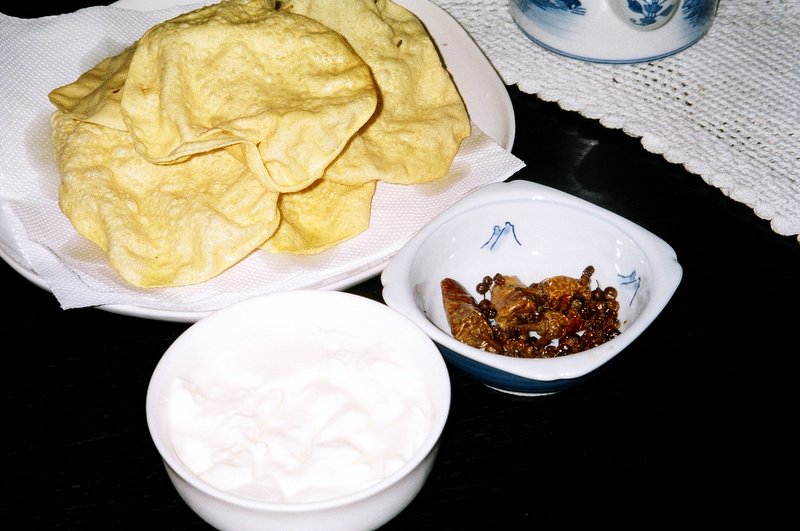
This picture shows some accompaniments to a traditional Tamilian meal: fried applams, fried tahir molaggai (dried red chillies stuffed with curd and salt) and a bowl of fresh sour curd.

::::::::::::::::::::::


I've been away from this blog for so long...but not away from the kitchen! Here is a delicious, very light and refreshing buttermilk curry recipe. This is a traditional Tamilian dish, and once again it's a recipe I learnt from my mother-in-law.

Curry leaves are an essential ingredient in the Tamil kitchen. A defining smell in my mother-in-law's kitchen in her Hyderabad apartment is the fragrant aroma of just fried 'tarka' -- crackling mustard seeds, crisply fried curry leaves and toasted brown fenugreek seeds in a teaspoon of oil -- the prepared tarka or fried seasoning is poured over freshly made dhals, curries or vegetables.

This buttermilk curry is finished with a similar tarka. Prepare the buttermilk fresh from sour yogurt (sour curd) to make this curry really delicious. In Tamil kitchens, buttermilk is prepared by briskly churning a bowlful of sour curds mixed with about a glassful of room temperature drinking water. Traditionally this buttermilk curry is made without the tomatoes, and the usual vegetable added is a few cubes of aubergines. I prefer using tomato as it gives the buttermilk a richer more defined flavor and goes well with the coconut paste.


The Recipe:


1 quantity buttermilk
1/2 a fresh coconut grated and ground into a smooth paste with 2 teaspoons toasted cumin seeds and 3 dried red chillies
handful of curry leaves
half a tomato diced
pinch of tumeric
salt
1/2 teaspoon fenugreek seeds
1 teaspoon black mustard seeds
little vegetable oil


Put about 1 cup of water in a pan and bring to the boil, lower heat and add tomatoes, a few of the curry leaves and tumeric and boil for about 5-6 minutes till tomatoes are soft and pulpy. Add the buttermilk and coconut mixture and stir well. Bring to the boil again, then reduce to a low flame and simmer at least 10 minutes till the mixture is well blended and the coconut mixture has lost its raw taste. Add salt to taste.


Seasoning:
Heat 1 teaspoon of vegetable oil, add a few curry leaves and the fenugreek seeds; stir quickly till seeds turn golden brown, add the black mustard seeds and remove from heat as soon as they start sputtering (be careful as this happens quickly especially if the oil is very hot). Pour this mixture into the buttermilk curry and serve hot with steamed white rice and a bit of lime or mango pickle and fried aaplams (poppadums).

Easy maccher jhol


This is how the fish pieces should look once you've shallow-fried them.
:::::::::::::::::::::


The other day as I was walking through Little India I came across a series of Bangladeshi eateries, one of which was called 'Radhuni' the name reminded me of the 'Radhuni' eatery on Free School Street in Calcutta, also run by Bangladeshis settled in Calcutta. When I was a student, we'd go to Radhuni sometimes and eat maccher kalia and rice. Radhuni was next door to Prince, another small dive with Bangla roots. On a recent trip back home I noticed that Radhuni had disappeared and Prince was looking shabbier than what I remembered it as.

It's difficult to cook traditional Bengali dishes away from home mostly because it isn't easy getting typical Bengali spices and cooking with the very pungent flavored mustard oil sometimes just isnt an option in a fancy rented apartment. So I've learnt to adapt my favorite Bengali dishes, making them easier to prepare and just as flavorful.

This simple maccher jhol (fish curry) takes about 20 minutes to prepare and along with plain boiled rice is a Bengali staple. Use any nice white fish -- here in Singapore I often use a local fish that looks a bit like rui maach; milk fish can also be used. Just don't use a very strong flavored fish like salmon as the point of this dish is the gravy (jhol) that the fish absorbs.

A note on paanch phoron: this is a typical Bengali spice and is basically five spices -- onion seed, fenugreek, fennel, radhuni (i don't know the English name for this) and cumin -- dry roasted and blended together. The spice can be bought ready mixed at Indian or Bangladeshi grocery stores that specialize in Bangla ingredients.


The Recipe

3-4 fish fillets cleaned, washed and patted dry on paper towels then rubbed with some salt and tumeric powder
1 tomato diced; another quartered
1 inch piece fresh ginger cut into small pieces
3-4 green chillies cut into small pieces; 2-3 slit whole green chillies
1 and a 1/2 teaspoon coriander powder
1 potato sliced into thick rounds
1 teaspoon paanch phoron
vegetable oil
1 teaspoon tumeric
salt
1 teaspoon sugar


In a frying pan that can be covered, heat about 2 tablespoons of oil till smoking hot then shallow fry the prepared fish fillets about 2-3 minutes each side till nice and golden and cooked through. If necessary cover the fish while it fries as some fish like milkfish tend to sputter dangeroulsy when fried in hot oil. Remove fried fish and keep aside.

Put the garlic, chillies and some salt in a mortar. Grind well into a thick paste; add the diced tomatoes and coriander powder and grind some more till tomatoes are mashed and the paste is thick but not too coarse.

Heat the frying pan (you may need to add a little more oil) and when nice and hot add the paanch phoron and then the ground spice paste. Take care not to burn the paanch phoron as this will make the curry bitter. Fry well till the paste is fragrant and oil separates from the paste.
Add the fish pieces and some more salt, sugar and fry till fish is well covered in the paste. Add about two cups warm water and the potato slices, quartered tomato and slit whole chillies. Bring to the boil, then reduce heat and simmer 10-12 minutes till potatoes are done.

Serve hot with steamed white rice or luchis.

Monday, February 20, 2006

Tomato pepper rasam

South Indian vegetarian meals are pretty standard: rice, sambhar, rasam, two vegetables, aaplam (papar or poppadums) pachadi or chutneys and yoghurt. I am not a big sambhar fan, but I do love the rasams. Rasam can best be described as very light spicy soup that sort of acts a palate cleanser, hence its rich flavors. This next recipe is something I learnt from my mother-in-law -- it's a delicious tomato peppery rasam and is best eaten piping hot.


The Recipe

1-2 medium sized fresh tomatoes quartered
1 tsp cumin seeds
2-4 tsps pepper powder, according to taste
a dash of hing (aesofetida powder)
salt to taste
a small lump of tamarind
4-6 curry leaves
a small sprig of coriander leaves
2 tablespoons cooked toowar dhal
2-3 cups water
mustard seeds
a little oil


In a thick-bottomed pan put the tomatoes with all the other ingredients except the mustard seeds and oil. Bring to a boil, then lower heat and simmer for at least 20-25 minutes adding more water if needed till tomatoes are pulpy and liquid tastes flavorful and peppery.
Heat a little bit of vegetable oil, add the mustard seeds. Once they start to splutter pour into the boiling tomato liquid, check seasoning and remove from heat. Strain and serve liquid rasam piping hot in small bowls, accompanied by steamed rice.

Sunday, February 19, 2006

Chingri Malai Curry

A close friend of mine lives a stone's throw away from the offices of Ananda Bazar Patrika, a large Calcutta-based newspaper group. His apartment, with its narrow staircase dark wood furniture, high ceilings and 'mystery doors' is a great place to settle down in the deep sofas and shoot the breeze for a couple of hours.

While my friend doesn't cook, he does have wonderful people around him who can cook wonderfully -- I have eaten the most traditional and delicious Bengali food at his place: deem boras, luchi, cholar dal, fish and prawn curries and fresh mishtis like kheerer chop, nolen gurer sondesh.

The recipe for chingri malai curry given below is a common Bengali way of preparing prawns (or shrimp) for special occasions. Here in Taipei, I have with great success, replicated the dish using frozen shrimp balls available at all Chinese supermarkets. Of course back in Calcutta it is made with fresh large shrimp.


The Recipe

Tiger or 'jumbo' or any large size prawns (cleaned and shelled) 500-750 grams
Thick coconut milk 1 cup
small green cardamoms 5-6
cloves 2-3
cinnamon 2
red chillie paste 1/2 teaspoon
ginger paste 1 teaspoon
tumeric powder 1 teaspoon
fresh chillies 4
ghee 2-3 tablespoons
sugar 1/2 teaspoon
salt to taste


Heat ghee, add cardamoms, cinnamon, cloves. Then add the prawns and fresh chillies slit down the middle, tumeric powder, chillie and ginger paste. Mix well and cook for about 5-6 minutes. Add the thick coconut milk, salt and sugar. Cook till gravy thickens -- about 10-12 minutes. Do not overcook as prawns turn rubbery. Add a tablespoon of ghee and remove from heat. Serve hot with steamed rice.

Rajasthani mixed dhal

Dhals or lentils are a staple at most Indian meals. Small and large grocers in most of urban India sell a variety of lentils ranging from the basic masoor and moong dhals, to urad and toowar (very common in south India) channa, lobia (white bean) and rajma (kidney beans).

There are regional favorite dhals and of course ways of preparing them that are region-specific too. In south India, toowar and urad dhals are cooked widely, in the north the bean dhals are more commonly used, in western India moong dhal is quite a favorite. Today's recipe is a tasty very filling dhal -- actually two dhals -- and is a commonly eaten among the Marwari community, that has its roots in the north Indian state of Rajasthan. As the dhal is very thick, when it is nearly cooked I use a potato masher to smoothen it a bit. Works pretty well giving the dhal a smooth, rich finish.


The Recipe


1/2 cup split Bengal gram dhal (chaana dhal)
1/2 cup white urad dhal
tumeric powder 1/2 teaspoon
chilli powder 1/2 teaspoon
coriander powder 1/2 teaspoon (mix these 3 powders with a little bit of water to make a paste)
cumin seeds 2 teaspoons
garam masala powder 1/2 teaspoon
ginger paste 1 teaspoon
garlic paste 1 teaspoon
diced onion 2 teaspoons
2-3 fresh chillies
salt to taste
a little vegetable oil

Wash and drain the dhals. Add about 4-6 cups water to the washed dhals and cook till soft with a bit of salt. It will take about 25-30 minutes to cook and soften. (Some people pressure cook the dhals, this reduces the cooking time). In a little oil, fry the cumin seeds, garam masala powder, ginger paste, garlic paste, onion and chillies for a couple of minutes. Add the spice powder paste to this and the cooked dhal and a bit of water water if it is too thick. Stir thoroughly and cook well for about 20 minutes. Check seasoning. If the finished dhal is too thick, use a potato masher to smoothen it a bit, add a little more water and boil another 10 minutes or so. Serve hot with freshly made chappatis.

Saturday, February 18, 2006

Matha diye Moonger Dhal

No Bengali lunch or dinner is complete without a delicious fish preparation. Bengali fish dishes are lightly spiced or fried and usually accompanied by white steamed (boiled) rice or luchis (a fried bread made from refined flour). One of my favorite Bengali fish dishes is 'matha diye moonger dhal' -- a strong flavored fish head preparation, rather easy to prepare once you have bought a cleaned fish head from your local fishmonger or supermarket.

The Recipe


1 cup moong dhal (easily available from any Indian grocery store)
1 tsp ground ginger paste
1 tsp cumin seeds (ground with the ginger paste)
2 tomatoes chopped
2 bay leaves
1 tsp sugar
1 tsp tumeric powder
1 fish head (use carp or any white fish)
1 tsp cumin seeds
1/2 tsp fenugreek seeds
salt to taste
3 cups hot water
2-3 fresh chillies
vegetable oil for frying


Rub the fish head with salt and tumeric powder and keep aside. Heat the oil and fry the moong dhal till it changes color slightly. Add 3 cups of hot water and let the dhal cook till almost done (about 25 minutes).
Add tomatoes and 2-3 fresh chillies slit down the middle. Add sugar, tumeric powder and a ginger and cumin paste. Add salt and boil well for a couple of minutes.
Fry the fish head and add to the boiling dhal. Reduce heat and simmer for 5 minutes. Remove from heat.
In a teaspoon of oil prepare a tarka (or seasoning) of fenugreek seeds, cumin seeds and bay leaves fried for about a minute and then add to the cooked dhal.

Friday, February 17, 2006

Amma's Mysore Pak

Like many Tamilian Brahmin ladies of her age, my mother-in-law loves preparing simple pure ghee based sweets in her kitchen. Tamilian Brahmins are a strict vegetarian community of southern India. Possibly because their dietary regulations have resulted in little variation of daily main dishes, Tamilian women produce such fantastic sweets on a more regular basis than other indian communities. Every Tamilian housewife will have her small repertory of favorite sweets and my mother-in-law's favorites include mysore pak (recipe below) badam halwa and a variety of payasams (rice puddings).

Indian sweets typically use a lot of sugar (or gur i.e. jaggery) and at least in the Tamilian kitchen are made in fairly small quantities. As most of these sweets use pure ghee they do last quite a while, but usually they'll just get eaten up pretty quickly as they are so delicious!

Mysore Pak is a traditional south indian sweet and is made of besan (Bengal gram flour). As with making cakes or pastries, the best sweets are made with very precise measurements. I have used the word 'cup' in the recipe, the important point to keep in mind is you need to use the same measuring cup for the sugar and the besan so as to keep the proportion correct. For best results prepare the sweet in a heavy-bottomed non-stick pan.


The Recipe

1 cup besan (Bengal gram flour) sifted
2 cups sugar (use a very fine white sugar)
a little water
1 cup pure ghee, you may need to add a few teaspoons more


Put the sugar in a thick-bottomed pan and pour just enough water to cover the sugar and place the pan on a medium flame. Stir almost constantly till the sugar syrup attains a two-thread consistency (this means when you put a drop of the sugar syrup on your thumb and press it with your forefinger it stretches into two thin 'threads').
Add the besan into this sugar syrup and stir constantly with a wooden spoon. After a minute or so, add the ghee a couple of tablespoons at a time and keep stirring. This bit needs a bit of skill because as you add the ghee the mixture will thicken so it needs to be stirred constantly. It helps to turn the heat down a bit, so that the mixture cooks through and thickens without burning. Keep adding the ghee and stirring the mixture for about 10-12 minutes, you may need to add a couple teaspoons ghee over 1 cup -- till the sweet achieves a nice creamy texture and has thickened almost to cake batter consistency. Then remove from heat.
Pour the finished sweet into a tray greased well with ghee. Leave to cool for about 20-30 minutes then cut the sweet into little cubes with a butter knife. As the sweet cools it will harden a little more.